Active Noise Cancelling vs Earplugs
They work on opposite halves of the spectrum, so pick by your noise. Here is the split, the concert case that is not a judgment call, and fit.
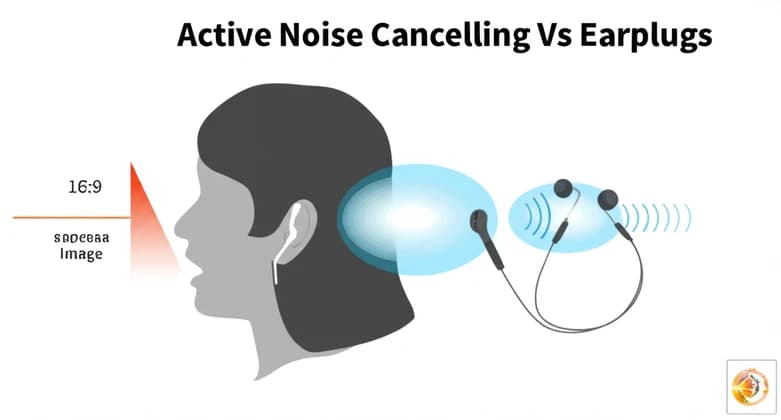
Earplugs block more total noise, active cancellation blocks the right noise, and they are strongest against completely different parts of the spectrum. Foam earplugs deliver 25 to 33 dB of attenuation concentrated in the mid and high frequencies. Cancellation delivers 20 to 30 dB below about 1 kHz and almost nothing above it. For an aircraft cabin, wearing both is better than either.
Choosing correctly comes down to knowing what frequency your problem lives at.
The split, and why it exists
Earplugs work by mass and seal. Sound has to pass through a physical barrier, and short wavelengths are stopped easily by a small obstruction while long ones pass around and through it. That is why passive attenuation is strong at high frequencies and weak at low ones.
Active cancellation works by producing an inverted waveform that sums with the incoming sound toward silence. The constraint is timing: the system has to detect, calculate and reproduce the anti-noise before the original arrives. At 1 kHz a wavelength is about 34 centimeters, so the entire loop has to complete in well under a millisecond.
Above roughly 1 kHz the wavelengths get short enough that the phase no longer lines up, and cancellation stops working. Below it, the technology has time to work and does so extremely well.
So the two are close to complementary. Earplugs cover exactly the range cancellation cannot reach, and cancellation covers exactly the range earplugs are weakest at.
What each is actually good at
| Noise | Better choice |
|---|---|
| Aircraft and train rumble | Cancellation, decisively |
| Snoring partner | Earplugs |
| Office conversation | Earplugs |
| Concerts and loud music | Earplugs, and only earplugs |
| Power tools and machinery | Earplugs, or plugs plus muffs |
| Air conditioning and building plant | Cancellation |
| Road traffic outside a window | Cancellation for the rumble, plugs for the rest |
| Sleeping on a plane | Both together |
Concerts are not a judgment call
This is the one case where the answer is absolute, and it is worth being direct about.
Noise cancelling headphones do not protect you at a concert. They are not rated as hearing protection, the cancellation does nothing at the frequencies that carry most of the damaging energy in amplified music, and wearing headphones at a gig is not practical anyway.
Concert levels reach 100 to 110 dB. At 100 dB, the safe exposure period is measured in minutes rather than hours, and the damage is permanent and cumulative.
Musicians’ earplugs are the right answer. Unlike foam, which cuts high frequencies far more than low ones and makes music sound muffled and dull, filtered earplugs are designed to attenuate roughly evenly across the spectrum. You get 15 to 20 dB of reduction and the music still sounds like music.
They cost little, fit in a pocket, and they are the difference between enjoying concerts for decades and developing tinnitus.
Reading the ratings honestly
Earplugs carry an NRR figure in the United States or an SNR figure in Europe, and both overstate real world performance.
The numbers come from laboratory tests with expert fitting. Real world attenuation is typically half to two thirds of the rating, because most people do not insert foam plugs correctly.
Foam plugs have to be rolled thin, inserted deep into the canal, and held while they expand. A plug sitting at the entrance of the canal achieves a fraction of its rating. This is the single largest variable in the whole comparison, and it is free to fix.
Cancellation figures are rarely quantified at all, and where they are, the number applies at one frequency rather than across the range.
Combining plugs and muffs does not add the two ratings together. The realistic gain from doubling up is around 5 dB over the better of the two, not the sum.
Wearing both
For a long flight, foam earplugs under noise cancelling headphones is genuinely the best combination available.
The plugs handle cabin chatter, announcements and the high frequency hiss of air rushing past. The cancellation handles the engine and airframe rumble that the plugs barely touch.
The catch is that you cannot listen to anything. If you want audio, sealed earbuds with foam tips and cancellation are the compromise, since the tips provide the passive isolation while the electronics handle the low end. Our comparison of earbuds against headphones for cancelling covers that trade.
For sleeping, plugs alone, since nothing over-ear is comfortable on your side.
For a workshop, plugs plus muffs, which is standard practice for a reason.
The practical differences nobody mentions
Earplugs cost almost nothing, need no charging, weigh nothing and cannot fail. That reliability is worth more than it sounds.
Cancellation requires power, and a flat battery on some models means no cancellation and sometimes no sound at all.
Plugs worn for hours raise humidity in the ear canal, and reusable ones need washing. Disposable foam should be discarded rather than reused.
Some people find cancellation produces a pressure sensation, like a change in altitude. It is not harmful and it is a real reason some people cannot use it.
Earplugs remove your awareness of everything, which makes them dangerous near traffic and useful for sleep. Cancellation with a transparency mode gives you a switch.
Plugs also block your own voice less predictably, producing the boomy occlusion effect that makes talking with them in feel strange.
Frequently asked questions
Are earplugs better than noise cancelling headphones?
They block more total noise and a different part of the spectrum. Foam plugs give 25 to 33 dB concentrated in the mid and high frequencies, where cancellation does almost nothing. Cancellation gives 20 to 30 dB below about 1 kHz, where plugs are weakest. Match the tool to your noise.
Can I use noise cancelling headphones at a concert?
No. They are not hearing protection, they are not rated as such, and cancellation does nothing at the frequencies carrying most of the damaging energy in amplified music. Use filtered musicians’ earplugs, which attenuate roughly evenly across the spectrum so the music still sounds right.
Can I wear earplugs and noise cancelling headphones together?
Yes, and for a long flight it is the best combination available. The plugs handle cabin chatter and high frequency hiss while the cancellation handles engine rumble. The realistic gain is about 5 dB over the better of the two rather than the sum of both ratings.
Why do my earplugs not block as much as the rating says?
Because the rating comes from a laboratory test with expert fitting, and most people insert foam plugs too shallowly. Roll the plug thin, insert it deep into the canal, and hold it while it expands. A plug sitting at the canal entrance achieves a fraction of its rating, and correcting that is free.