Are Marshall Speakers Good?
Built by a Swedish company under license, not by the amp makers. Here is how they really sound, why the bass is limited, and if the premium is fair.
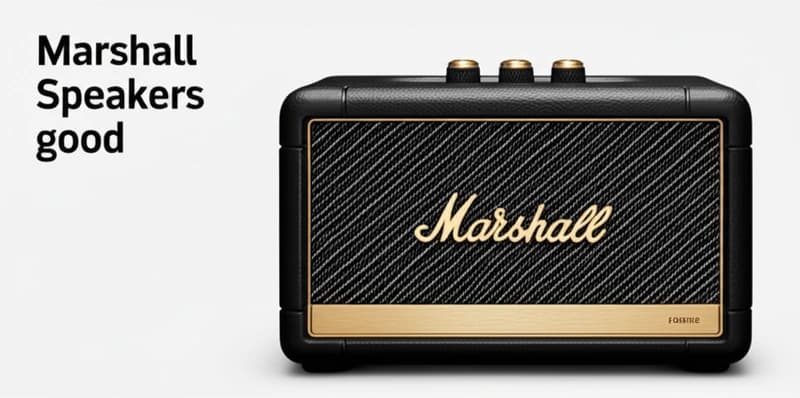
Marshall speakers are well made and pleasant to listen to, and they are not built by the company that makes the guitar amplifiers. The consumer audio range was created under license by Zound Industries, a Swedish company, starting in 2010. Zound then acquired Marshall Amplification outright in 2023, forming Marshall Group, with the Marshall family retaining a substantial minority stake.
That history matters, because it explains both what the speakers are good at and what you are paying for.
What you are actually buying
The styling is genuine. The vinyl wrap, the fret cloth, the script logo and the gold control knobs are the real visual language of Marshall amplifiers, used with the family’s involvement rather than imitated.
The engineering is consumer audio engineering. A Bluetooth speaker is a different design problem from a guitar amplifier, which is deliberately colored and distorting because that is the sound. A speaker reproducing recordings is trying to do the opposite.
So do not expect a Marshall speaker to sound like a Marshall stack, and do not treat that as a criticism. They are unrelated products that share a look.
What you get is a competent Swedish designed consumer speaker in a very distinctive cabinet.
How they sound
The tuning across the range is warm and midrange forward, with a slight lift in the upper bass that gives them body.
That balance suits rock, guitar music and vocals particularly well, which is a sensible decision given who buys them. Voices sit forward and guitars have weight.
It suits electronic music and anything depending on deep bass extension less well, and that limitation is largely physical rather than a tuning choice.
Producing low bass requires moving air, and how much air a speaker can move depends on cone area and excursion, both constrained by cabinet size. A compact speaker cannot produce 40 Hz at volume regardless of how it is engineered or what the specification claims. The larger models in the range do noticeably better simply because there is more cabinet.
Treble is smooth rather than detailed, which makes them easy to listen to for hours and less impressive on a direct comparison.
The controls are a real advantage
The knobs are not decoration. Physical bass, treble and volume controls with detents, adjustable without reaching for a phone or opening an app, are genuinely more pleasant to use than touch panels.
The analog treble and bass controls also cover most of what you would want an equalizer for, and they are quicker.
Build quality is solid across the range. The vinyl wrap resists marking, the metal grilles are properly attached, and these are products that look the same after two years, which is not universal.
The larger home models with a mains connection are the strongest part of the lineup, since the cabinet volume and the power supply are both working in your favor.
The value question
You are paying a premium for the design, and how much depends on which model.
Judged on sound per pound alone, several competitors beat them at every price. Judged as an object you will have on a shelf for years, the calculation changes, and that is a legitimate way to buy a speaker rather than a mistake.
The portable models are where the premium is most noticeable, since compact Bluetooth speakers are a fiercely competitive category and the physics limits everyone equally.
The larger home speakers make a stronger case, because the cabinet is doing real work and the comparison set is smaller.
Sales are frequent and the discounts are substantial, so paying full price is rarely necessary.
Which one suits which use
| Use | What to look for |
|---|---|
| Desk or bedside | Smallest models, where size is the point |
| Living room, single speaker | Larger mains powered models, where the cabinet earns its keep |
| Outdoors and travel | Portable range, checking the water resistance rating |
| Party volume | Look elsewhere, or at the largest models only |
| Bass heavy electronic music | Look elsewhere unless you buy large |
| Guitar music and vocals | Any of them, this is what the tuning is for |
Placement changes them more than you expect
Putting a speaker near a wall reinforces its bass, and putting it in a corner reinforces it further, because the room boundaries stop low frequencies radiating away in every direction.
On a compact model that is worth several decibels of low end for free, which is more than any setting will give you.
The cost is definition. Corner placement adds quantity and takes away clarity, so a few inches out from the wall is usually the better compromise.
Height matters too. Ear level, or aimed at ear level, keeps the treble where you can hear it, since high frequencies are directional in a way bass is not.
Hard surfaces underneath add brightness and resonance. A soft mat under a speaker on a glass shelf is a small change with an audible result.
Frequently asked questions
Are Marshall speakers good?
They are well built, warm sounding and pleasant for long listening, particularly with guitar music and vocals. They are not the best sound per pound in any category, and the compact models are limited in deep bass by cabinet size rather than by tuning. Buying one partly for how it looks is a reasonable decision.
Are Marshall speakers made by the amplifier company?
Now, effectively yes, though not originally. The consumer speakers and headphones were made under license by Zound Industries, a Swedish company, from 2010. Zound acquired Marshall Amplification in 2023 to form Marshall Group, with the Marshall family as a significant shareholder. The engineering behind the speakers is consumer audio rather than guitar amplification.
Do Marshall speakers have good bass?
Good upper bass and limited deep bass on the compact models, which is a physical constraint. Producing low frequencies at volume needs cone area and cabinet volume that a small speaker does not have. The larger mains powered models do considerably better, and moving any of them closer to a wall adds low end for free.
Are Marshall speakers worth the price?
On sound alone, no, since several competitors offer more at the same price. On design, build and the physical controls, the premium is defensible if those things matter to you. The larger home models make the stronger case, and discounts are frequent enough that paying full price is rarely necessary.