Are Sonos Speakers Good?
You are buying software as much as speakers, and that cuts both ways. Here is what the system does brilliantly and the dependency 2024 exposed.
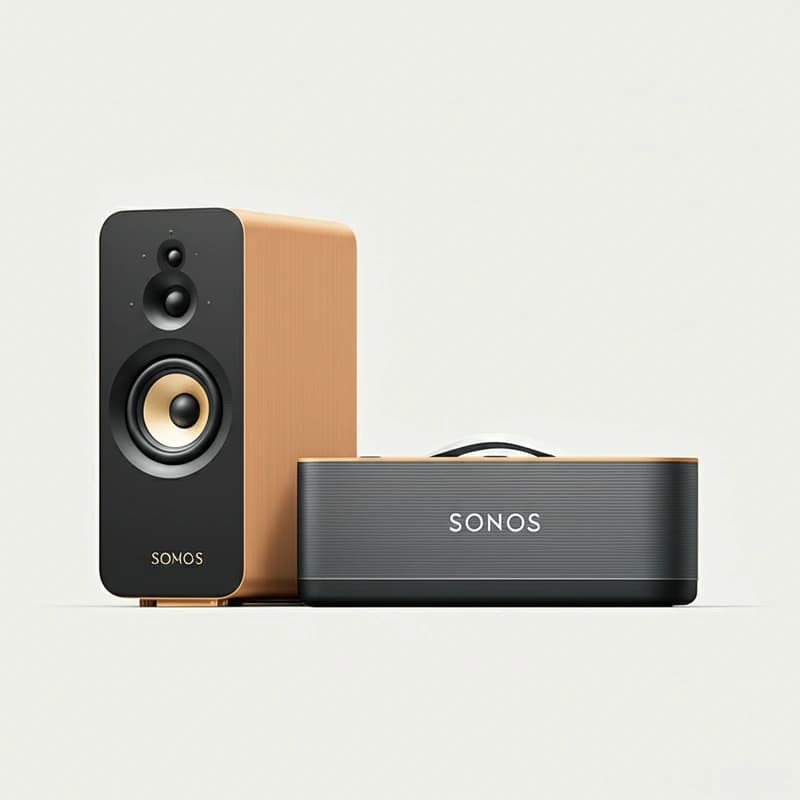
Sonos speakers are good, and you are buying a software system rather than a set of speakers. The multi-room synchronization is the best in the business, the room correction genuinely works, and the hardware sounds better than its size suggests. The risks are all on the software side, and the 2024 app rewrite demonstrated exactly what that dependency means.
Judging Sonos as speakers alone misses both the strength and the risk.
What the system does that others do not
Multi-room synchronization is the core, and it is genuinely hard engineering. Speakers in different rooms play the same audio in exact time, which requires each unit to hold a shared clock over an unreliable network.
Being a few milliseconds out is audible as an echo when you walk between rooms. Sonos gets this right consistently, and most competitors do not.
The reason is that Sonos speakers run on Wi-Fi rather than Bluetooth. That gives them a proper network connection with the bandwidth and timing control synchronization needs, and it removes the range limit and compression that Bluetooth imposes.
It also means they are streaming directly from the service rather than from your phone, so a call or a phone leaving the house does not interrupt anything.
The trade is that most home Sonos speakers have no Bluetooth at all. If your Wi-Fi is down, they largely do not work, which surprises people.
Trueplay is the underrated part
Room correction is the feature that actually justifies the price, and many owners never run it.
A room does severe things to sound. Reflections from walls, floor and ceiling arrive after the direct sound and combine with it, reinforcing some frequencies and cancelling others. Room dimensions create standing waves that produce large peaks and dips at low frequencies. Two identical speakers in two rooms measure completely differently.
Trueplay plays test tones while you walk around waving a phone, measures what actually arrives at various positions, and adjusts the speaker’s output to compensate.
The improvement is usually larger than the difference between two speakers at adjacent price points, particularly for a speaker placed near a wall or in a corner where bass reinforcement is severe.
Run it after any change in placement or furniture, and run it again if a room changes.
The software dependency, honestly
This is the real argument against Sonos and it deserves a straight account.
In 2024 the company released a rewritten app that removed features owners relied on and introduced significant reliability problems. Speakers people had bought years earlier became difficult to use, through no change to the hardware. It took many months to recover, and it damaged trust in a way the hardware quality does not repair.
The general lesson matters more than the specific incident. A Sonos speaker is not usable as a plain speaker if the software fails, because there is no analog input on most models and no Bluetooth to fall back on.
There is also the legacy device question. Sonos has previously ended support for its oldest hardware, which is unavoidable eventually but is a different proposition from a passive speaker that works forever.
None of that makes the products bad. It means you are buying into an ongoing relationship with a company rather than buying an object, and that is a real distinction worth making deliberately.
How the hardware actually sounds
Better than the size suggests and not better than the price would buy in passive speakers.
The tuning is warm and midrange forward, aimed at sounding good in a normal room at moderate volume rather than at neutrality. That is the right choice for the product.
The compact models are limited in deep bass by cabinet volume, exactly as any small speaker is, and no processing overcomes the amount of air a small cone can move.
The soundbars are strong products, and the dialogue clarity is a genuine improvement over any television.
A pair of decent passive bookshelf speakers with a small amplifier will beat an equivalently priced Sonos on sound alone. What they will not do is play in sync with four other rooms, correct themselves for your room, or be controlled from a phone anywhere in the house.
Who it suits
People who want audio in several rooms, which is the case the whole system is built for and where nothing else competes as well.
People who value the experience working reliably every day over extracting maximum sound quality per pound.
People building a system gradually, since units combine and a stereo pair or a surround setup can be added later.
People who want a soundbar that will grow into a surround system without replacing anything.
People who want the best possible sound in one room for the money should buy passive speakers and an amplifier. Our piece on whether Polk speakers are good covers that end of the market.
Practical advice for owners
Use a wired connection to at least one unit if you can, since it stabilizes the whole system.
Give the speakers a 5 GHz network where possible, and keep the 2.4 GHz band clear of congestion.
Run Trueplay in every room, and again whenever anything moves.
Set up a stereo pair rather than two separate speakers in one room, since the imaging improvement is substantial.
Keep at least one alternative input in the house, whether that is a model with a line input or a separate Bluetooth speaker, so a software problem does not leave you with nothing.
Buy on sale, since the products discount predictably and rarely need to be bought at full price.
Frequently asked questions
Are Sonos speakers good?
Yes, with the caveat that you are buying a software system rather than speakers. The multi-room synchronization is the best available, Trueplay room correction genuinely works, and the hardware sounds better than its size suggests. Equivalently priced passive speakers with an amplifier sound better in one room.
Do Sonos speakers work without Wi-Fi?
Mostly not. Sonos home speakers use Wi-Fi rather than Bluetooth, which is what makes the synchronization and streaming work, and most models have no Bluetooth and no analog input as a fallback. Some portable models do include Bluetooth, so check the specific product if that matters to you.
Is Trueplay worth running?
Yes, and it is the most underused feature. A room reinforces some frequencies and cancels others through reflections and standing waves, and two identical speakers measure completely differently in two rooms. The improvement usually exceeds the gap between adjacent price points, especially for speakers near a wall.
What happened with the Sonos app?
A rewritten app released in 2024 removed features and introduced serious reliability problems, leaving speakers people already owned difficult to use for months. The hardware was unchanged. The lasting point is that a Sonos speaker depends on working software in a way a passive speaker never does.