Are Wired Headphones Safer Than Wireless?
Only against a risk never demonstrated, and they can worsen the real one. Here is the evidence on both, and the number actually worth checking.
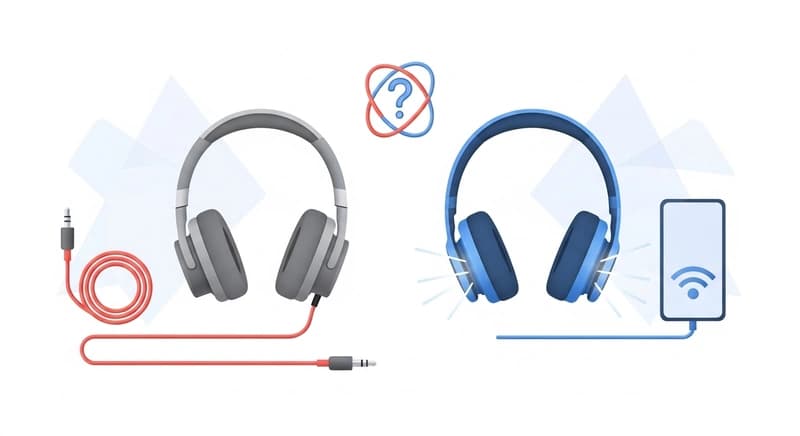
Wired headphones avoid a risk that was never demonstrated, and can increase the one that is. The radiation concern rests on a misread classification and a misattributed petition. The genuine risk to your hearing is listening volume, and a wired pair that isolates poorly in a noisy place makes you turn it up, which is the mechanism that actually causes harm.
Both halves of that are worth going through properly, because the question is asked in good faith and the usual answers are unsatisfying.
The radiation claim, examined
Two things drive it, and both are misreadings.
The IARC classifies radiofrequency electromagnetic fields as Group 2B, possibly carcinogenic. That category indicates limited evidence rather than demonstrated risk, it covers all radiofrequency exposure rather than headphones specifically, and the same category contains aloe vera extract and pickled vegetables. It describes how strong the evidence is that something could cause cancer under some conditions, not how large any risk is.
Separately, a 2019 news cycle reported that hundreds of scientists had warned about wireless earbuds. The document was a general appeal about electromagnetic field exposure from all sources, submitted years earlier, not written about earbuds, and containing no new research. The misattribution has persisted since.
On the physics: Bluetooth is non ionizing, meaning individual photons carry roughly a millionth of the energy needed to break a chemical bond. Bluetooth headphones transmit around 2.5 milliwatts, against up to 2 watts for a phone held against your head.
So if radiofrequency exposure concerns you, the phone in your hand is the dominant source by a factor of several hundred, and wireless headphones actually reduce your total exposure by keeping the phone away from your head during calls.
The risk that is real
Noise induced hearing loss is well established, permanent and cumulative. It depends on level and duration together.
Sustained exposure at 85 dB carries risk over a working day, and every 3 dB above that halves the safe duration. At 100 dB the safe period is measured in minutes.
The biggest driver of how loud you listen is how much background noise you are competing with. In a quiet room people choose a moderate level. On a train, they raise it until the music wins.
This is where the format matters. A pair that isolates well, whether by sealing or by cancellation, lets you listen 10 to 15 dB quieter for the same clarity. That is a large difference in exposure over years.
Most wired headphones, particularly the open backed and loose fitting ones people already own, isolate poorly. Most wireless headphones sold today seal or cancel.
Where wired genuinely wins
No battery, which means no lithium cell to swell, no capacity decline, and no product that becomes disposable after three years.
Lower cost for equal sound, since none of the money goes into radios, batteries, processing or a charging case. A wired pair at USD 150 generally beats a wireless pair at USD 250.
No latency, which matters for video editing, music production and gaming.
No compression. Bluetooth compresses audio and the cable does not.
Longevity, since a wired headphone with replaceable pads and a detachable cable can last a decade.
Zero radio emission, which is a genuine advantage if it matters to you personally, even though the risk was never demonstrated.
Where wired is worse
Cables are a strangulation risk for children in bed, which is a real and documented hazard that wireless does not have.
Cables snag, which is a genuine hazard on a treadmill or near machinery.
Poor isolation on many wired designs, which is the volume problem above.
Cable damage over time, since conductors fatigue where the cable meets the plug, though a detachable cable makes that a cheap fix.
Fewer devices with a headphone socket, meaning an adapter, which is another thing to lose.
Comparing them on what matters
| Concern | Safer option |
|---|---|
| Radio emission | Wired, though the risk is unestablished |
| Hearing damage from volume | Whichever isolates better in your environment |
| Children in bed | Wireless, cables are a strangulation hazard |
| Ear canal infection | Whichever you wear less continuously |
| Traffic awareness | Either, with transparency mode or one ear free |
| Battery hazards | Wired, though the risk is very small |
What to actually do
Check your weekly headphone exposure figure, which both iOS and Android track. Most people are surprised, and it is the only number in this whole discussion with a demonstrated link to harm.
Keep the volume below about 60 percent of maximum as a rough guide, and take breaks on long sessions.
Use isolation rather than volume in noisy places, whichever format that means for you.
Use volume limited headphones for children, and enable the operating system limit as well.
Wash silicone tips weekly and let your ears breathe, since sealed wear raises humidity in the canal.
If the radio question still bothers you after reading this, buy wired. It costs nothing extra and often less. Just choose a pair that isolates properly, so you are not trading a hypothetical risk for a demonstrated one. Our piece on the claims made about wireless headphones goes through each one.
Frequently asked questions
Are wired headphones safer than wireless?
Only on radio emission, which was never demonstrated as a risk. On hearing damage, which is the established risk, whichever pair isolates better in your environment is safer, since better isolation lets you listen 10 to 15 dB quieter. Wired headphones also carry a strangulation hazard for children that wireless does not.
Do Bluetooth headphones emit dangerous radiation?
There is no established evidence and no plausible mechanism at these power levels. Bluetooth is non ionizing, so its photons carry nowhere near the energy needed to break chemical bonds, and headphones transmit around 2.5 milliwatts against up to 2 watts for a phone at your head.
What is the real risk from headphones?
Volume, and it is the only risk with a clear mechanism and clear evidence. Sustained exposure at 85 dB carries risk over a working day, and every 3 dB above halves the safe duration. The damage is permanent and cumulative. Check the weekly exposure figure your phone already tracks.
Should I switch to wired headphones?
Only if you want to, and there are good reasons unrelated to safety: no battery to fail, better sound per pound, no latency and no compression. If you switch for safety reasons, choose a pair that isolates well, since a poorly isolating wired pair makes you listen louder in noisy places.