Do You Need Speakers for a Turntable?
Yes, plus the part most people never hear about. Here is why records are cut with the bass removed, and what to do if yours sounds thin and quiet.
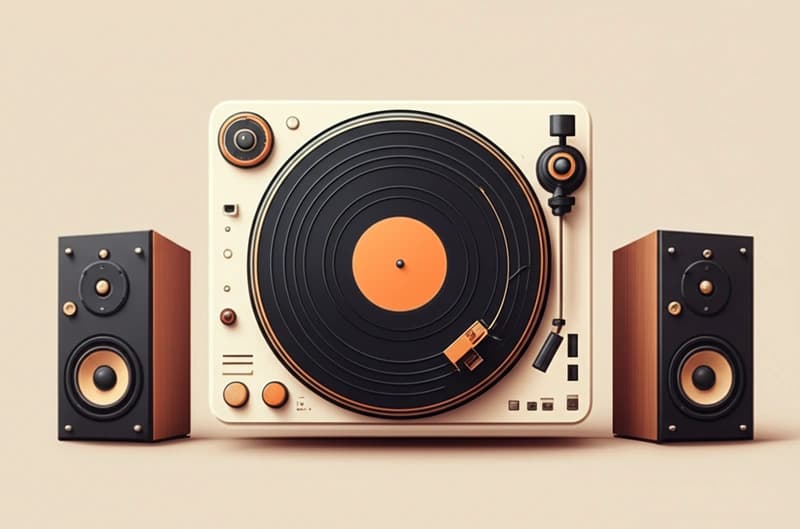
Yes, and you also need something most people do not know exists: a phono preamp. A turntable produces a signal roughly a thousand times weaker than a phone or a CD player, and that signal has been deliberately distorted in a specific way when the record was cut. Without a phono stage to fix both problems, a turntable plugged into speakers sounds thin, quiet and wrong.
Understanding why is the difference between a system that works and a shelf of parts that do not.
The signal chain
Four things have to happen between the groove and your ears.
The cartridge converts the stylus movement into a tiny electrical signal, typically a few millivolts.
The phono preamp boosts that to line level and reverses the equalization applied when the record was cut.
The amplifier raises line level to a level capable of driving speakers.
The speakers turn that into sound.
Every one of those stages exists in every setup. What varies is whether they are separate boxes or built into something else.
Why the phono stage is not optional
Records are not cut flat, and this is the part that surprises people.
When a record is mastered, the bass is reduced and the treble is boosted according to a defined standard called the RIAA curve. There are two reasons. Bass needs large groove excursions, so cutting it flat would mean very wide grooves and a few minutes of music per side. And boosting the treble at the cutting stage means the surface noise added later sits further below the signal.
The phono preamp applies the exact inverse: it boosts the bass back and reduces the treble back, restoring the original balance.
That correction is substantial, roughly 20 dB of bass boost and 20 dB of treble cut across the range. Skip it and you hear a record with almost no bass and harsh, exaggerated treble.
Combined with the missing gain, this is exactly why a turntable connected to a line input sounds quiet and thin. Nothing is broken.
Where the phono stage might already be
| Location | How to tell |
|---|---|
| In the turntable | A switch marked Phono and Line on the back |
| In the amplifier | An input labeled Phono, with a ground screw beside it |
| In powered speakers | The specification says phono input or built-in preamp |
| Separate box | A small unit sitting between turntable and amplifier |
You need exactly one of these, not two. Running a turntable with its preamp switched on into an amplifier’s phono input applies the correction twice and overloads the input, which sounds distorted and loud.
An input labeled Aux, Line or CD is not a phono input, regardless of the connector being identical.
Your speaker options
Powered speakers with a built-in phono stage are the simplest complete answer. The turntable connects directly, no amplifier is needed, and the whole system is two boxes.
Powered speakers without a phono stage work if your turntable has one built in, or with a separate preamp between them.
Passive speakers with an amplifier is the traditional route and the one that scales. It costs more boxes and gives you far more upgrade paths, and a secondhand receiver with a phono input is frequently the cheapest good option available.
Bluetooth speakers work if the turntable has Bluetooth output, and the connection compresses the audio and adds latency. For vinyl specifically this is a strange choice, since the appeal of the format is the analog signal path.
Turntables with built-in speakers, the suitcase style ones, are worth being blunt about. The speakers are too small to produce meaningful bass, and the tracking force and stylus quality on the cheapest of them can wear records over time.
Choosing speakers for vinyl
Sensitivity matters if you are using a low powered amplifier, since a 91 dB speaker plays as loud on one watt as an 88 dB one does on two.
Placement matters more than the speakers. Get the tweeters to ear height, pull them away from the wall behind, and form a triangle with your listening position.
Isolation from the turntable matters in a way it does not for other sources. Bass from the speakers travels through the floor and furniture into the turntable, where the stylus picks it up and plays it again. That loop is called acoustic feedback and it produces a low rumble that grows with volume.
Keep the turntable off the same surface as the speakers, use a wall shelf or an isolation platform, and never put a turntable on top of a speaker.
A subwoofer works well with vinyl but needs a high pass filter on the main speakers and careful level setting, since the feedback problem gets worse as bass output rises.
Getting the setup right
Connect the ground wire. Turntables have a thin separate wire with a spade connector that attaches to the ground screw on the amplifier or preamp. Without it you get a loud hum, and this is the single most common setup complaint.
Set the tracking force with a stylus gauge to the cartridge manufacturer’s figure. Too light causes mistracking and record wear, too heavy causes wear as well.
Level the turntable with a spirit level, since an unlevel plinth loads one groove wall more than the other.
Set the anti-skate to match the tracking force on decks that have it.
Replace the stylus at the recommended interval, usually somewhere between 500 and 1000 hours. A worn stylus damages records permanently, and that is the most expensive mistake in vinyl.
Frequently asked questions
Do you need speakers for a turntable?
Yes, and you also need a phono preamp and an amplifier. The preamp is the part people miss. A turntable produces a signal about a thousand times weaker than other sources, and the recording has deliberate equalization applied that only a phono stage reverses. Some turntables, amplifiers and powered speakers include one.
Why does my turntable sound quiet and thin?
Because it is connected to a line input with no phono stage in the chain. Records are cut with the bass reduced and the treble boosted, and a phono preamp reverses that while adding about 40 dB of gain. Without it you hear a quiet recording with almost no bass and harsh treble.
Can I connect a turntable straight to powered speakers?
Only if a phono stage exists somewhere in the chain, either built into the turntable or into the speakers. Check the turntable for a Phono and Line switch, and the speaker specification for a phono input. Use one preamp only, since applying the correction twice distorts and overloads.
Why does my turntable hum?
Almost always the ground wire. Turntables have a separate thin wire with a spade connector that must attach to the ground screw on the amplifier or phono preamp. If it is disconnected or the screw is loose, you get a loud hum. Check that before anything else.