Smart Soundproofing Devices for Homes
No device blocks sound, and some genuinely help anyway. Here is what masking, monitoring and automation really do, and how to judge a claim.
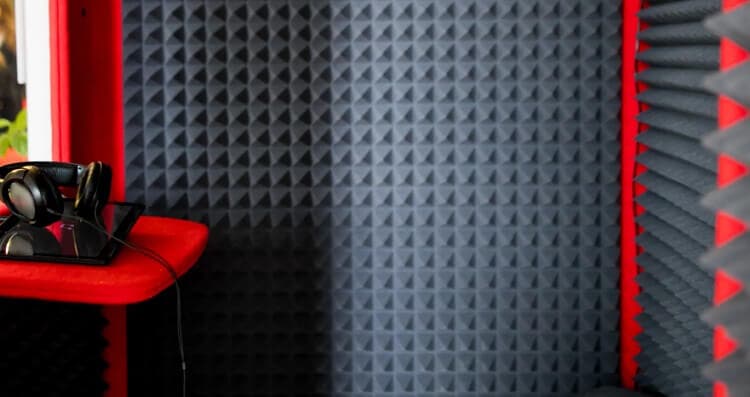
No smart device makes a wall soundproof, and the ones that genuinely help work by masking, monitoring or automating rather than by blocking. Blocking sound requires mass, decoupling and airtightness, which are construction properties that no amount of processing substitutes for. What smart devices do well is manage the noise you cannot remove, and that is a real and useful category.
Separating the two is the difference between a useful purchase and a disappointing one.
Why electronics cannot block sound
Airborne sound transmission through a partition is governed by mass, stiffness, damping and the air gap. Doubling the mass of a wall buys roughly 5 to 6 dB. Decoupling the two leaves so vibration cannot bridge them buys considerably more. Sealing every gap is what stops the rest.
None of those is something a device does. A speaker generating anti-noise in a room cannot cancel across an entire volume, because cancellation only works where the two waves meet in exact opposition, which is a region a few centimeters across at speech frequencies.
Room-scale active cancellation exists in research and in narrow applications like duct silencers and headrests, where the space is confined and the frequency range is low. It does not scale to a bedroom.
Any product claiming to cancel noise for a whole room is either doing masking and calling it cancellation, or overstating what it does.
Sound masking, the one that genuinely works
Masking is the most effective electronic approach, and it works on a real principle.
A steady background sound raises the level at which other sounds become noticeable. It does not remove the neighbor’s television, it removes your ability to pick it out from the background, which is what was actually bothering you.
The important insight is that intermittent noise is far more disturbing than constant noise at the same level. A steady hum is something you stop hearing. A voice that comes and goes is something your brain keeps attending to. Masking converts the second into the first.
Smart white noise machines add scheduling, gradual fade, room-specific profiles and app control, all of which are genuinely useful. Setting a machine to fade up as the neighbors come home is a real solution.
Commercial sound masking systems used in offices distribute carefully shaped noise through ceiling speakers, tuned to the frequency range of speech so conversations become unintelligible a few desks away. This is established practice rather than a gadget.
Choose broadband noise weighted toward the lower frequencies rather than hissy white noise, which is fatiguing.
Noise monitoring, which is more useful than it sounds
Devices that measure sound levels continuously and log them do not reduce anything, and they change what you can do about it.
For a noise complaint against a neighbor, a landlord or a business, a dated log of levels is evidence where a description is not. Councils and housing associations respond differently to data.
For finding a source, a logger identifies when noise actually occurs, which is frequently different from when you think it does.
For a home office or a nursery, monitoring tells you whether a problem is as bad as it feels.
Consumer devices are not calibrated instruments and their absolute readings should not be presented as measurements. What they are good at is showing relative levels and timing, which is usually what matters.
Phone apps do the same job less accurately, since phone microphones are tuned for voice and roll off at both ends of the spectrum.
Automation that helps
The useful smart home applications are indirect, and they work because they act on the physical path.
Automated window and blind closing on a schedule addresses the largest weak point in any facade. An open window has essentially no acoustic performance, so closing it before rush hour matters more than any device in the room.
Heavy motorized curtains add a small amount of absorption and a useful amount of psychological benefit, though the acoustic effect is modest and frequently overstated.
Scheduling noisy appliances, dishwashers and washing machines, away from sleeping hours is trivially easy with smart plugs and removes a real source.
Smart ventilation lets you keep windows shut without the room becoming stuffy, which is the reason people open them in the first place. This is probably the highest value smart intervention in a noisy area and it is rarely framed as a noise product.
Noise triggered automations, such as lights or a masking machine responding to a detected level, are possible and mostly novelty.
What to spend on instead, in order
Seal the gaps. Sound follows air, and a gap under a door can undo the performance of the whole door. Draught excluders, acoustic seals and filling penetrations around pipes and sockets cost very little and deliver more than most products.
Address the windows, which are almost always the weakest element. Secondary glazing with a wide air gap outperforms replacement double glazing for noise, because the gap width matters more than the glass.
Add mass where you can. A second layer of board on a wall, with a damping compound between the layers, is the standard approach.
Decouple where the budget allows, using resilient channels or independent framing, which prevents vibration bridging the structure.
Then add masking for whatever remains, which is where the smart device earns its place.
Our guide on how urban noise is actually controlled covers the same hierarchy at a larger scale.
Judging a product claim
Ask what physical mechanism is involved. Mass, decoupling, sealing, absorption and masking are the real ones. If a claim does not reduce to one of those, treat it skeptically.
Be wary of decibel reduction claims without a frequency range attached, since a product can be honest about 4 kHz and useless at 100 Hz.
Distinguish absorption from blocking. Acoustic panels reduce reverberation inside a room and do almost nothing to stop sound entering it, which is the most common misunderstanding in the whole field.
Treat any claim of whole room noise cancellation as marketing.
Check whether a smart feature actually adds anything, since a scheduled masking machine is useful and an app-controlled acoustic panel is a panel with an app.
Frequently asked questions
Do smart soundproofing devices actually work?
The ones that mask, monitor or automate do. The ones that claim to block or cancel noise across a room do not, because blocking sound requires mass, decoupling and airtightness, which are construction properties. Active cancellation only works in a small region around the listener, which is why it exists in headphones and not in rooms.
Can a device cancel noise in a whole room?
No. Cancellation requires the anti-noise wave to meet the original in exact opposition, which only happens in a region a few centimeters across at speech frequencies. Room scale versions exist in research and in confined low frequency applications like ducts, and they do not scale to a bedroom.
Is a white noise machine better than soundproofing?
It is different rather than better, and it is cheaper. Masking does not remove the noise, it removes your ability to pick it out of the background, which is usually what was bothering you. Intermittent sound is far more disturbing than constant sound at the same level, and masking converts one into the other.
What should I do before buying any noise device?
Seal the gaps, since sound follows air and a gap under a door can undo the whole door. Then address the windows, which are almost always the weakest element in a facade. Then add mass. Masking is worth adding for what remains after that, not as a substitute for any of it.