Which Soundbar Is Better?
Channel counts are not a ranking, and the middle digit is the one that matters. Here is how to read them and which specs actually decide it.
The better soundbar is the one matched to your room and your actual problem, and for most households that means a 3.1 configuration rather than a higher channel count. The middle digit is the center channel, which is where nearly all dialogue lives, and dialogue is the problem most people are actually trying to solve. Channel counts above that depend on your room cooperating.
Comparing soundbars starts with reading the numbers correctly.
What the channel numbers mean
| Configuration | What is in it |
|---|---|
| 2.0 | Left and right only, no subwoofer |
| 2.1 | Left, right and a subwoofer |
| 3.1 | Adds a dedicated center channel for dialogue |
| 5.1 | Adds separate rear speakers |
| 5.1.2 | The last digit is upward firing height channels |
| 7.1.4 | More rears and four height channels |
The first digit is speakers around you at ear level. The second is subwoofers. The third, where present, is height channels firing at your ceiling.
The most useful thing to know is that these are not a ranking. A 3.1 bar in a suitable room comfortably beats a 5.1.2 bar in an unsuitable one, because the extra channels depend on reflections your room may not provide.
Which configuration for which problem
If dialogue is the problem, and it usually is, a 3.1 configuration is the direct fix. A driver dedicated to the center channel reproduces speech without it competing for the same drivers as everything else.
Anything with a 2 as the first digit is asking one pair of drivers to handle dialogue, music and effects together, and processing to separate them is not the same as separate hardware.
If bass is the problem, the second digit is what matters, and a wireless subwoofer that you can position properly matters more than its size.
If immersion is the goal, rears do more than height channels for most rooms, because rear placement works in any room while height channels need a specific ceiling.
If your room is open plan, virtual surround and height processing both largely fail, and a good 3.1 with a subwoofer is the honest answer.
Height channels need the right ceiling
This is the specification that most often disappoints, and the reason is geometric.
Upward firing drivers bounce sound off your ceiling so it arrives at your ears from above. That requires a flat, hard, reflective ceiling at a normal height, roughly 2.4 to 3.5 meters.
Sloped ceilings send the reflection somewhere other than your seat. Beamed or coffered ceilings scatter it. Very high ceilings weaken it past usefulness. Acoustic tiles absorb it entirely, which is exactly what they are designed to do.
If your ceiling is any of those, height channels are money spent on a feature that cannot function, and no setting compensates.
Ceiling mounted or in-ceiling speakers do work in those rooms, at considerably more cost and installation effort.
Virtual surround, honestly
Single bar surround processing works by timing and phase manipulation so sound appears to come from beside you, using reflections off your side walls.
It works genuinely well in a rectangular room with hard parallel side walls and a centered seating position.
It works poorly in an open plan space with no side wall on one side, in a room with large soft furnishings against the walls, or when you sit off center.
The manufacturer’s demonstration room is the ideal case. Yours probably is not.
Physical rear speakers work in any room because they do not rely on reflection, which is why a 5.1 bar with real rears beats a virtual 5.1 in most homes.
The specifications worth comparing
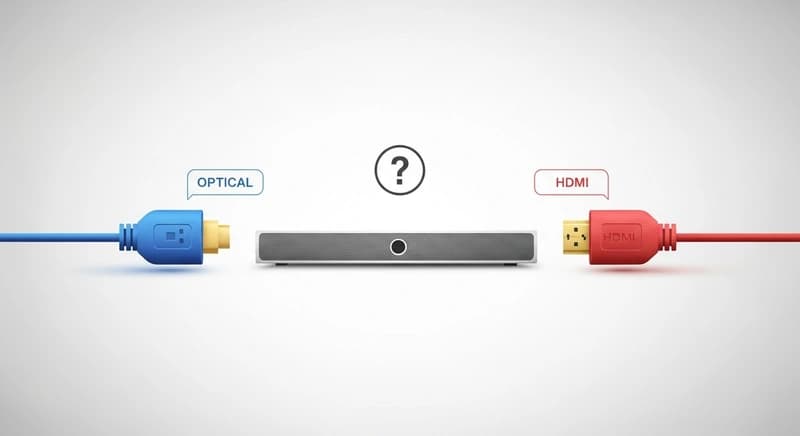
Whether it has HDMI eARC rather than only ARC or optical. eARC carries the full quality formats and optical carries none of them.
Whether the subwoofer is wireless, since a wired one has to sit near the bar and subwoofer position changes bass more than subwoofer quality does.
Whether rears can be added later, which lets you buy in stages rather than replacing the whole thing.
Whether there is a dedicated dialogue or clarity mode, which lifts the frequencies carrying intelligibility.
Whether it has room correction, which measures what actually arrives at your seat and compensates. On a soundbar this matters more than usual, because the bar is often in a compromised position.
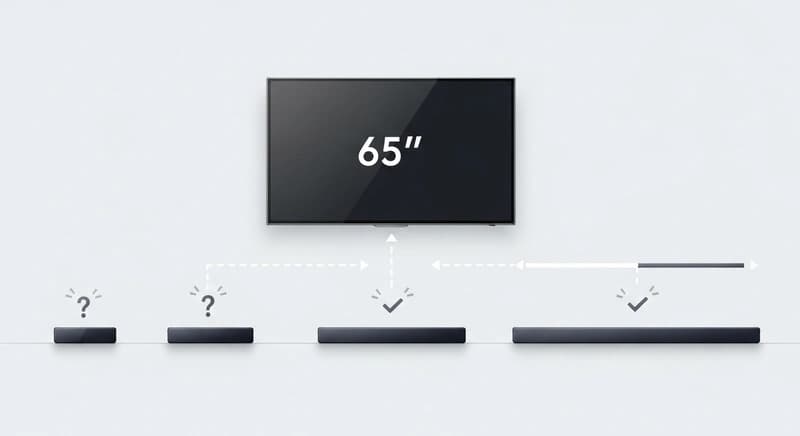
Whether the physical size suits your television and furniture, since a bar wider than the screen looks wrong and a bar that blocks the screen bottom is worse.
What does not decide it
Total wattage, which is not comparable between manufacturers and rarely measured to any standard.
Driver count, since eight small drivers in a thin cabinet do not beat four in a deeper one.
Brand alignment with your television. Matching brands sometimes adds a convenience feature and never determines sound quality.
Format logos on the box. Support for a format means it can decode it, not that it reproduces it well.
Price alone above about USD 800, where separates start winning outright. Our piece on whether a soundbar is worth it covers where that line falls.
Placement decides more than the model
Put the bar directly below the screen at ear height when seated, with nothing in front of it. A bar inside a cabinet loses most of what you paid for.
Keep a few inches between the bar and the wall if it is rear ported.
Find the subwoofer position by putting it in your listening seat, playing something bass heavy, and crawling the floor until it sounds best. Then put it there. This looks ridiculous and works better than any rule.
Turn the subwoofer level down from wherever you first set it, since almost everyone sets it too high.
Place rears slightly behind and above ear height, and resist putting them further back than the manufacturer suggests.
Frequently asked questions
Which soundbar configuration is better?
For most households, 3.1, because the middle digit is a dedicated center channel and dialogue is the problem people are usually solving. Higher channel counts are not a ranking, since a 3.1 bar in a suitable room beats a 5.1.2 bar in a room whose ceiling or walls cannot support the extra channels.
Are Dolby Atmos height channels worth it?
Only with a flat, hard ceiling at a normal height, roughly 2.4 to 3.5 meters. Upward firing drivers rely on the ceiling reflecting sound down to your seat. Sloped, beamed, very high or acoustically treated ceilings scatter or absorb that reflection, and no setting compensates for it.
Is a 5.1 soundbar better than a 3.1?
If the rears are physical speakers, usually yes, since rear placement works in any room. If the 5.1 is virtual, produced by bouncing sound off your side walls, it depends entirely on having hard parallel walls and a centered seat. In an open plan room, a good 3.1 is the better choice.
What should I compare between soundbars?
HDMI eARC rather than ARC or optical, whether the subwoofer is wireless so you can position it properly, whether rears can be added later, and whether there is room correction. Ignore total wattage and driver count, since neither is comparable between manufacturers.